Thai Food – Introduction
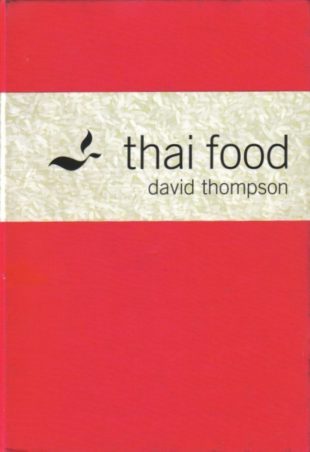
Thai Food by David Thompson catapults straight into the pantheon of great cookbooks because it brilliantly captures the essentials of an entire cuisine. And this is not a minor regional cuisine, but one of the most complex and wide-ranging cuisines of the world. It is also one that is understood by very few Western authors or chefs.
Thompson, however, is a master of both writing and cooking – we have enjoyed his complex cooking for many, many years and continue to do so. We also enjoy his precise and authoritative writing on the topic of Thai food.
David Thompson is one of those rare individuals who quietly moves into a different culture, absorbs it and then communicates the essence of that culture to the rest of the world.
We have learned more about Thai cooking from reading his books and other writings than from anyone else.
We had known of David Thompson and his extraordinary knowledge of Thai cuisine long before the publication of this seminal work. We had been
lucky enough to work in Sydney for three or four years in the nineteen nineties and his Sailor’s Thai Canteen became our canteen.
Every week, on arriving in Sydney, we would make the Canteen our first dinner stop. We would love the sensation of walking through the door of the building in the Rocks and seeing the array of happy diners at the long, gleaming stainless steel table that stretched the length of the restaurant. A seat would soon be found for us and we would then happily peruse the menu to see what corners of Thai cuisine were being explored that week.
Thai Food – the book
When the Thai Food released in July 2002 we bought it the day it hit the shelves. A paragraph in the introduction resonated:
“Thai cooking is at odds with the modern world, where speed and simplicity are paramount. Thai is not an instant cuisine, prepared with the flick of a knife and finished with the toss of a pan. It needs the cook’s attention, it expects time and effort to be spent and it requires honed skills, but it rewards with sensational tastes.”
At a time when a generation of food writers were dumbing food down so that fewer ingredients and less time have become the norm, here was a writer prepared to declare to his readers that this was going to tough if you want to reap the rewards!
And this also explains why we think that Thai food should have a much more venerated place among the cuisines of the world. Unfortunately, there are very few good examples of Thai cuisine in restaurants outside Thailand. Most food writers equate the second rate fare they are served up in the United States and Europe with the cuisine of Thailand.
To experience true Thai flavours you need to wander the streets and alleys of Bangkok or Chiang Mai and sample the street food or eat in one of the rambling wooden restaurants where the Thais go. You generally need to avoid the hotels and shopping centres as the food usually has been made less complex to cater for western tastes.
This is a large and rewarding book. We say rewarding because every sentence adds something to your understanding of Thai cuisine. Also, the photographs by leading Australian photographer Earl Carter illustrate the importance of the visual attraction of the ideas being presented.
The first main section of Thai Food is a beautiful 30 page vignette of the history of Thailand, the Thai people and Thai customs. This sets the scene for the 30 page discussion of food and Thai customs that follows. In fact setting of the scene is so important that the first recipe does not appear until page 149 – but you have learned so much on the journey so far.
Thompson’s recipes give no quarter. They are not, as in the case of so many Thai books, simplified to the point of meaninglessness. The flavours are not overly dumbed down to suit timid palates. For this reason, some may have difficulty with Thai Food because it demands a lot – but it also gives a lot!
So, if you want to use dried fish in a recipe then there are clear instructions on how to dry your own fish. If you think you can take a shortcut by using a food processor rather than pounding the ingredients in a mortar a pestle then it is allowed, but you are warned that it won’t have the right taste or texture.
If you want to use coconut milk from a can then it won’t deliver the ethereal results of the fresh products. You can even ferment your own bamboo shoots.
And speaking of fermentation, Thompson even includes a recipe in Thai Food for one of the world’s great taste sensations – the wonderful sai grop brio (fermented pork sausages) from northern Thailand.
You will need to prepare this recipe well ahead of when you want to eat them as they need to ferment for about a week – however the slightly sour undertone combined with the texture achieved through the use of fatty pork and steamed sticky rice is memorable.
There is little doubt that this classic by a great chef and writer deserves a place in the Foodtourist Top Fifty Coobooks list.
There is an interesting article on the High Life site about David Thompson and his new restaurant in Hong Kong called Aaharn.
David Thompson, The Australian Maestro of Thai Cuisine
You can order this book from Amazon by clicking on the link below: